
Configuración de la línea de ensamblaje de motocicletas CKD: Herramientas, Plantillas y Capacitación de Operadores
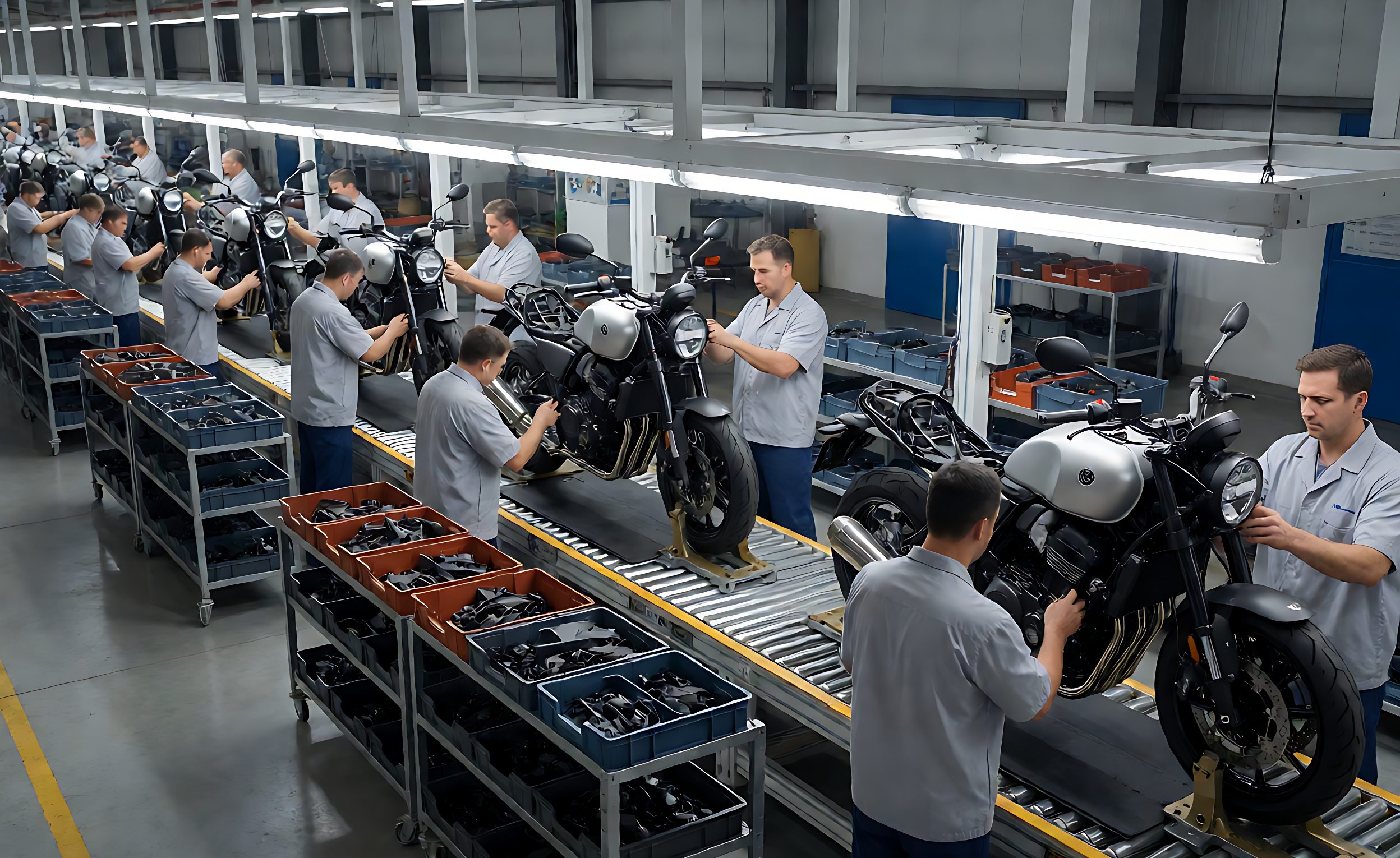
CKD parece un arbitraje sencillo: enviar las piezas, ensamblarlas localmente, pagar menos aranceles y menos flete. El arbitraje es real, y es exactamente la razón por la que tantos programas de CKD rinden por debajo de lo esperado. Los ahorros se calculan en la factura de envío, mientras que el coste de una línea que no puede mantener el par, la secuencia o la limpieza se manifiesta meses después como reclamaciones de garantía y una red de distribuidores que deja de creer en la marca.
Esta guía trata sobre la parte que decide si la aritmética funciona: la propia línea. Secuencia de estaciones y tiempo de takt, la lista de herramientas que realmente importa, diseño de plantillas, capacitación de operadores, puertas de calidad y una curva de ramp-up realista en lugar de una fantástica.
Lo que realmente contiene CKD
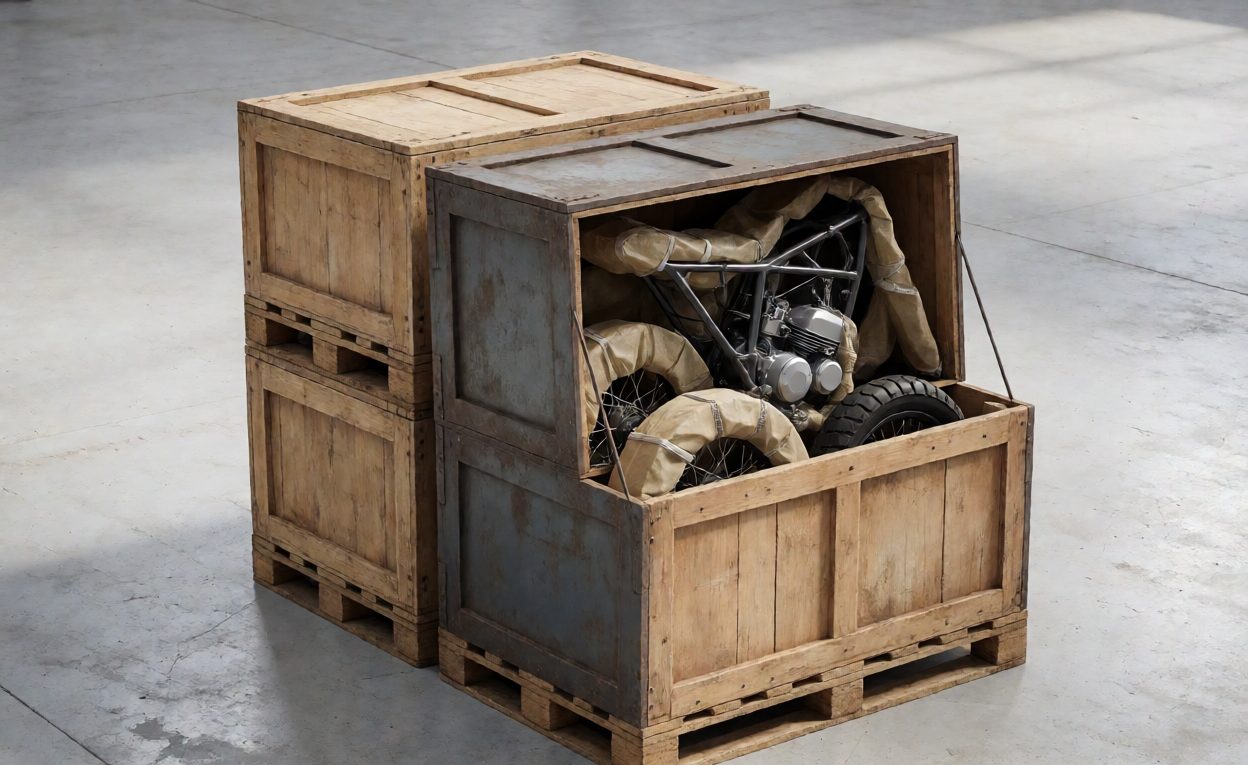
Un kit CKD no es una motocicleta desensamblada en el sentido que la mayoría imagina. Las piezas se empaquetan por secuencia de ensamblaje en lugar de por sistema, y el plan de embalaje determina qué tan rápido se puede alimentar a la línea.
- Chasis y balancín: usualmente el artículo individual más grande y el elemento estructural de la caja.
- Motor: completo o parcialmente ensamblado, enviado en su propia carrocería protectora.
- Ruedas y neumáticos: a menudo se envían como conjuntos, a veces separados para ahorrar volumen.
- Carrocería y plásticos: los artículos más propensos a dañarse, empaquetados por separado con espuma o pasta moldeada.
- Eléctrico: arnés, batería (seca), instrumentos, iluminación.
- Pernos y pequeñas piezas: embalados por estación, que es el detalle que decide si el ensamblaje es fluido o una búsqueda de piezas.
El empaquetado por estación en lugar de por tipo de pieza es la mejora barata más significativa en un kit CKD. Un kit donde cada perno para la estación tres está en la bolsa tres se ensambla en una fracción del tiempo de uno donde los elementos de sujeción llegan ordenados por tamaño.
La comparación entre CBU, SKD y CKD explica la aritmética de aranceles y flete. El supuesto enterrado en esa aritmética es que el coste de ensamblaje local es predecible, y ese supuesto depende del diseño de la línea.
Secuencia de Estaciones y Tiempo de Takt
Una línea CKD pequeña suele operar de ocho a doce estaciones, y la secuencia sigue la lógica física de construir hacia afuera desde el chasis.
- Estación 1: chasis en soporte, rodamientos de la cabeza de dirección, horquilla delantera.
- Estación 2: instalación del motor y soportes del motor, ajustados al par especificado.
- Estación 3: balancín, amortiguador trasero, transmisión por cadena o correa.
- Estación 4: ruedas, frenos, purgado y ajuste de frenos.
- Estación 5: enrutado del arnés eléctrico, batería, instrumentos.
- Estación 6: iluminación, interruptores, bocina y prueba de función eléctrica.
- Estación 7: carrocería, asiento, tanque de combustible, fluidos.
- Estación 8: inspección final, prueba en carretera, ajuste y embalaje para entrega.
El tiempo de takt es el tiempo de trabajo total disponible dividido por la producción requerida. Para una línea que funciona ocho horas con una meta de dieciséis motocicletas, el takt es de treinta minutos, lo que significa que ninguna estación puede tardar más de treinta minutos o se convertirá en el cuello de botella. Medir los tiempos reales de las estaciones en la primera semana es la única manera de saber si el plan sobrevive al contacto con la realidad, y la respuesta suele ser que una estación tarda el doble de su margen asignado.
El listado de herramientas que importa
Los listados de herramientas en proyectos CKD tienden a ser largos y sin diferenciaciones. Estos son los elementos que realmente determinan la calidad.
- Llaves de par calibradas: al menos tres rangos, con un registro de calibración y una verificación diaria. El par de apriete es el defecto de ensamblaje número uno en operaciones CKD.
- Equipamiento para levantar o sujeción de motores: un motor es pesado y de manejo difícil, y un motor caído es un motor desperdiciado.
- Equipamiento para purgar frenos: purga por vacío o presión, no bombeo manual, porque el aire en una línea de freno es un defecto de seguridad que llega al cliente.
- Balanceo de ruedas: balanceo estático o dinámico, que muchas líneas pequeñas omiten y luego culpan a los neumáticos.
- Equipamiento de prueba eléctrica: un multímetro y un conector de diagnóstico, más una secuencia de pruebas de función definida.
- Air line with a dryer: moisture in the air line contaminates brake fluid and paint, and a dryer is cheap.
- Fluid dispensing: measured dispensing for oil and brake fluid, so fill quantities are repeatable.
Quality perception is built at these stations. A buyer who inspects a showroom bike is really inspecting the discipline of the line that built it.
Jigs and Fixtures
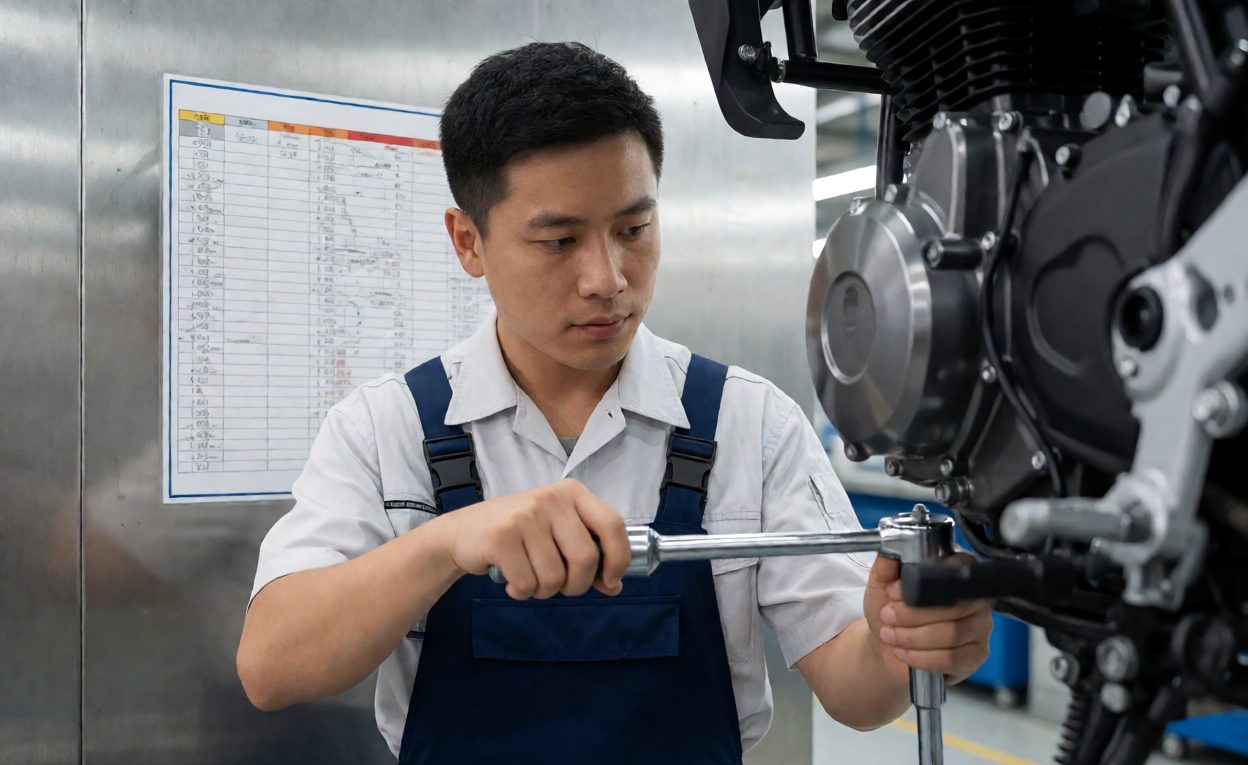
Three fixtures do most of the work, and each has a specific purpose.
Frame stand. Holds the frame at working height and allows rotation. Without one, operators work at floor level, which slows assembly and increases the chance of damage to the frame and to the operator. A stand with a rotating cradle pays for itself in the first week.
Engine cradle. Supports the engine during installation and alignment, so the mounts can be fitted without loading the bolts. An engine hung on bolts before alignment is an engine that will vibrate.
Wheel and alignment fixture. Holds the front end straight while the fork, handlebar and wheel are aligned. Misalignment shows up as a bike that pulls to one side, which is a warranty claim that is almost impossible to argue against.
Fixtures should be locally manufacturable from drawings, because importing them defeats part of the CKD cost advantage and creates a long lead time for replacements.
Training and Documentation
Operators on a new CKD line are usually competent mechanics and unfamiliar with this specific product. The gap is not skill, it is product knowledge, and it closes with documentation rather than experience.
- Work instruction per station: photographs of each step, the torque value, the tool, and the check that confirms the step is complete.
- Torque tables: posted at the station in the operator’s language, not buried in a manual.
- First-off inspection: the first bike of each shift is inspected in full before the line continues.
- Ramp-up plan: expect roughly half output in week one, seventy to eighty percent in week two, and full rate by week three or four, with a defined intervention if the curve is flat.
A training plan that assumes full rate from day one produces a month of defects that are attributed to parts quality rather than to the line, which is the most expensive kind of misunderstanding in a CKD programme.
Quality Gates and the Rework Loop
Quality gates are only useful if the rework loop feeding them is measured. Four gates cover a small line.
- In-station check: the operator confirms the step against the work instruction before the bike moves.
- Torque audit: a sample of fasteners marked and re-checked at the end of the line, with a recorded pass rate.
- Function test: electrical, braking, lighting and fluid leaks, on every unit.
- Road test: a short dynamic check on every unit, with a defined route and a defect log.
Warranty terms should reflect what the line can actually control. A programme that offers a full warranty without a torque audit and a road test is transferring line defects into the warranty budget, where they cost several times more to resolve.
A Realistic Ramp-Up
Assume a line designed for sixteen bikes per shift. Week one might produce eight with heavy rework, week two twelve with moderate rework, week three fifteen, and week four sixteen with a stable defect rate. The first month’s average is well below design capacity, and the business case should be built on that average rather than on the design rate. A plan that assumes design rate from week one produces a cash flow surprise in the same month the first container of parts arrives.
Dealer and territory terms should be set after the line has demonstrated a stable rate, because a dealer network that is signed up before the line can supply it becomes a network that is waiting.
Technical Background
CKD assembly is an application of assembly line principles at small scale: work is divided into stations, each station completes a defined scope within a takt time, and flow replaces batch build. The economics only work when station times are balanced, which is why measuring them is the first task rather than the last.
Much of the quality outcome depends on jigs and fixtures, which locate a part rather than simply hold it. A fixture that constrains the wrong degrees of freedom forces the operator to compensate by hand, and hand compensation is variable. The third influence is lean manufacturing thinking applied honestly: standard work, visual control and a measured rework loop, rather than a set of tools adopted for appearance.

A Line Setup Checklist
- Kit packed by station, with fasteners bagged per station rather than per size.
- Station sequence defined and station times measured in the first week.
- Takt time calculated from available hours and required output, not from aspiration.
- Calibrated torque wrenches in three ranges, with a daily check and a calibration record.
- Frame stand, engine cradle and wheel alignment fixture available locally.
- Work instruction per station with photographs and torque values in the local language.
- Four quality gates operating, with the rework loop measured.
- Ramp-up curve agreed with the parts supply plan, so parts arrive at the rate the line can absorb.
How many stations does a CKD motorcycle line need?
Typically eight to twelve for a small programme, moving from frame and fork through engine, running gear, electrical, bodywork and final inspection. The count follows takt time rather than a fixed template.
What is takt time and why does it matter?
Available working time divided by required output. It sets the maximum time any station may take, and a single station over takt becomes the constraint for the whole line.
What is the most common CKD assembly defect?
Incorrect torque, usually from uncalibrated wrenches or missing torque tables at the station. It is also the defect most likely to become a safety issue.
Should jigs be imported or made locally?
Locally, from supplied drawings, wherever local fabrication capability exists. Importing fixtures adds lead time and cost, and makes replacements slow when one is damaged.
How long does ramp-up take?
Plan for roughly half output in week one, seventy to eighty percent in week two, and full rate by week three or four, with a defined intervention if output stalls.
Do we need a road test on every unit?
Yes on a small line. A short dynamic check catches brake, alignment and electrical defects that a static inspection misses, and it is the cheapest warranty prevention available.
How should parts be packed for CKD?
By assembly station, with fasteners bagged per station. Packing by part type looks tidy in the warehouse and costs hours on the line.