
CKD Motorcycle Assembly Line Setup: Tools, Jigs and Operator Training
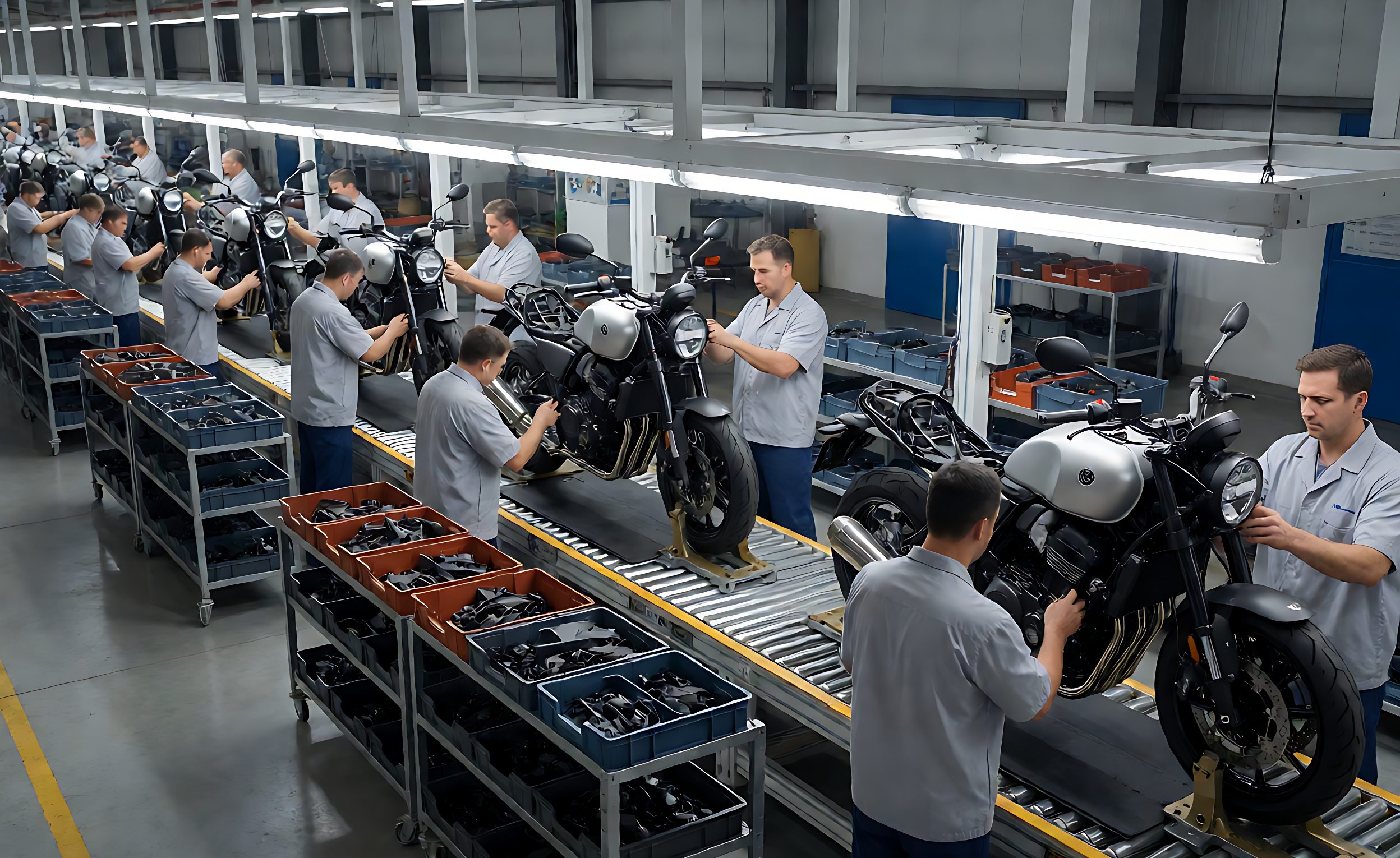
CKD looks like a straightforward arbitrage: ship the parts, assemble them locally, pay less duty and less freight. The arbitrage is real, and it is exactly why so many CKD programmes underperform. The savings are calculated on the shipping invoice, while the cost of a line that cannot hold torque, sequence or cleanliness shows up months later as warranty claims and a dealer network that stops believing the brand.
This guide is about the part that decides whether the arithmetic works: the line itself. Station sequence and takt time, the tool list that actually matters, jig design, operator training, quality gates, and a realistic ramp-up curve instead of a fantasy one.
What CKD Actually Contains
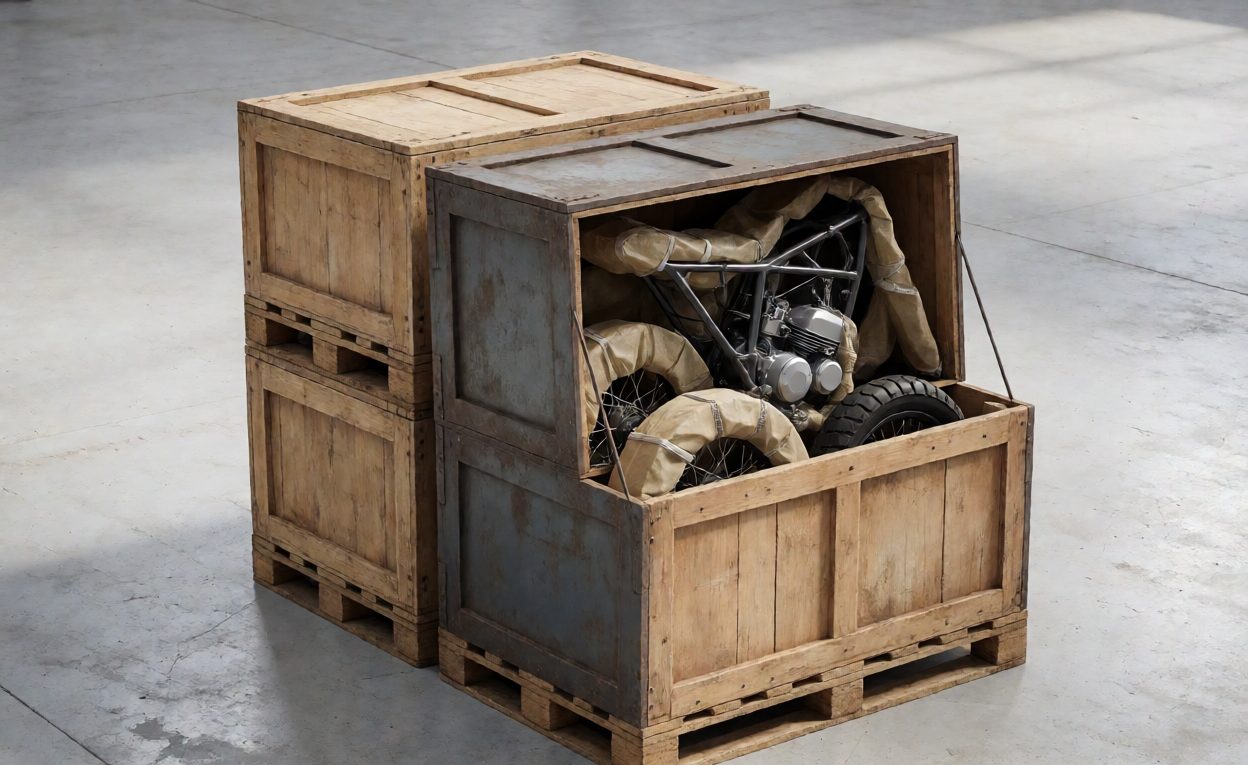
A CKD kit is not a disassembled motorcycle in the sense most people imagine. Parts are packed by assembly sequence rather than by system, and the packing plan determines how quickly the line can be fed.
- Frame and swingarm: usually the largest single item and the crate’s structural element.
- Engine: complete or partly assembled, shipped in its own protective cradle.
- Wheels and tyres: often shipped as assemblies, sometimes separated to save volume.
- Bodywork and plastics: the most damage-prone items, packed separately with foam or moulded pulp.
- Electrical: harness, battery (dry), instruments, lighting.
- Fasteners and small parts: bagged by station, which is the detail that decides whether assembly is smooth or a scavenger hunt.
Bagging by station rather than by part type is the single biggest cheap improvement in a CKD kit. A kit where every bolt for station three is in bag three assembles in a fraction of the time of one where fasteners arrive sorted by size.
The CBU, SKD and CKD comparison explains the duty and freight arithmetic. The assumption buried in that arithmetic is that local assembly cost is predictable, and that assumption depends on the line design.
Station Sequence and Takt Time
A small CKD line typically runs eight to twelve stations, and the sequence follows the physical logic of building outward from the frame.
- Station 1: frame on stand, steering head bearings, front fork.
- Station 2: engine installation and engine mounts, torqued to specification.
- Station 3: swingarm, rear shock, chain or belt drive.
- Station 4: wheels, brakes, brake bleeding and adjustment.
- Station 5: electrical harness routing, battery, instruments.
- Station 6: lighting, switches, horn, and electrical function test.
- Station 7: bodywork, seat, fuel tank, fluids.
- Station 8: final inspection, road test, adjustment and packing for delivery.
Takt time is total available working time divided by required output. For a line running eight hours with a target of sixteen bikes, takt is thirty minutes, which means no station may take longer than thirty minutes or it becomes the constraint. Measuring actual station times in the first week is the only way to know whether the plan survives contact with reality, and the answer is usually that one station takes double its allowance.
The Tool List That Matters
Tool lists in CKD projects tend to be long and undifferentiated. These are the items that actually determine quality.
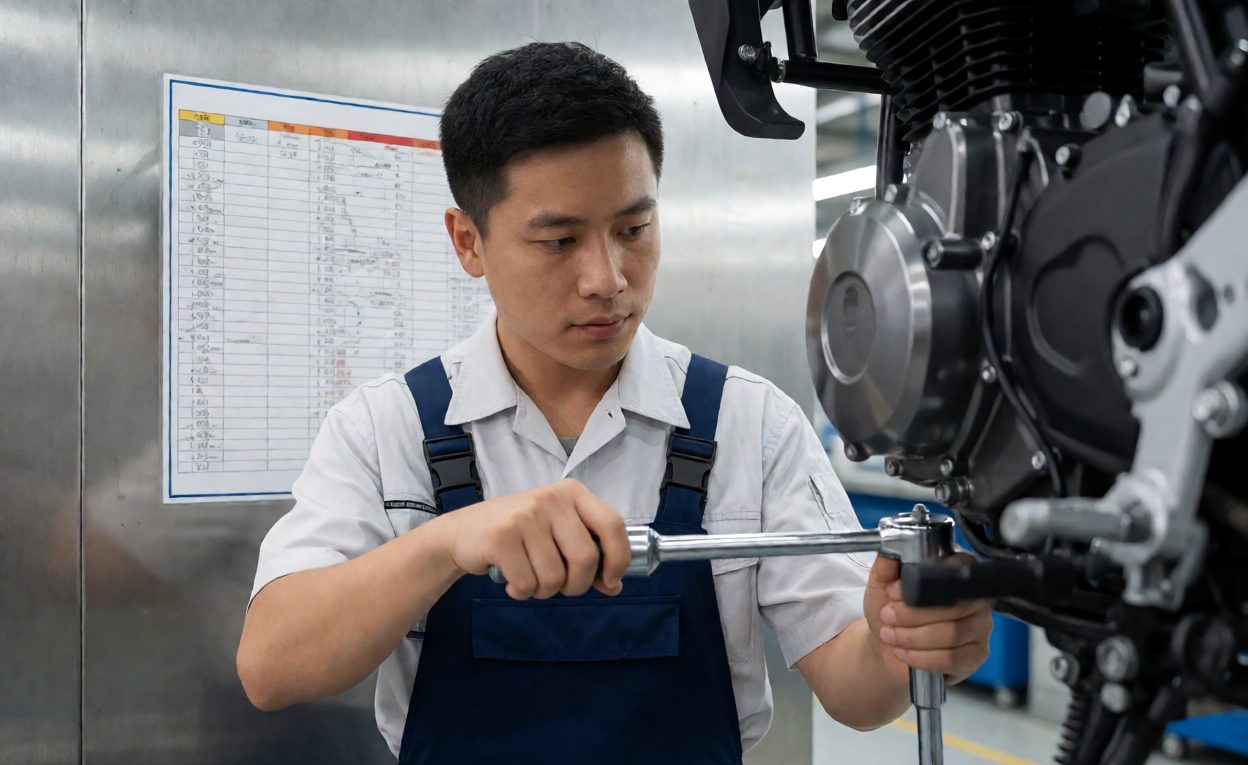
- Calibrated torque wrenches: at least three ranges, with a calibration record and a daily check. Torque is the number one assembly defect in CKD operations.
- Engine lifting or cradle equipment: an engine is heavy and awkward, and a dropped engine is a scrapped engine.
- Brake bleeding equipment: vacuum or pressure bleeding, not manual pumping, because air in a brake line is a safety defect that reaches the customer.
- Wheel balancing: static or dynamic balancing, which many small lines skip and then blame on tyres.
- Electrical test equipment: a multimeter and a diagnostic connector, plus a defined function test sequence.
- Air line with a dryer: moisture in the air line contaminates brake fluid and paint, and a dryer is cheap.
- Fluid dispensing: measured dispensing for oil and brake fluid, so fill quantities are repeatable.
Quality perception is built at these stations. A buyer who inspects a showroom bike is really inspecting the discipline of the line that built it.
Jigs and Fixtures
Three fixtures do most of the work, and each has a specific purpose.
Frame stand. Holds the frame at working height and allows rotation. Without one, operators work at floor level, which slows assembly and increases the chance of damage to the frame and to the operator. A stand with a rotating cradle pays for itself in the first week.
Engine cradle. Supports the engine during installation and alignment, so the mounts can be fitted without loading the bolts. An engine hung on bolts before alignment is an engine that will vibrate.
Wheel and alignment fixture. Holds the front end straight while the fork, handlebar and wheel are aligned. Misalignment shows up as a bike that pulls to one side, which is a warranty claim that is almost impossible to argue against.
Fixtures should be locally manufacturable from drawings, because importing them defeats part of the CKD cost advantage and creates a long lead time for replacements.
Training and Documentation
Operators on a new CKD line are usually competent mechanics and unfamiliar with this specific product. The gap is not skill, it is product knowledge, and it closes with documentation rather than experience.
- Work instruction per station: photographs of each step, the torque value, the tool, and the check that confirms the step is complete.
- Torque tables: posted at the station in the operator’s language, not buried in a manual.
- First-off inspection: the first bike of each shift is inspected in full before the line continues.
- Ramp-up plan: expect roughly half output in week one, seventy to eighty percent in week two, and full rate by week three or four, with a defined intervention if the curve is flat.
A training plan that assumes full rate from day one produces a month of defects that are attributed to parts quality rather than to the line, which is the most expensive kind of misunderstanding in a CKD programme.
Quality Gates and the Rework Loop
Quality gates are only useful if the rework loop feeding them is measured. Four gates cover a small line.
- In-station check: the operator confirms the step against the work instruction before the bike moves.
- Torque audit: a sample of fasteners marked and re-checked at the end of the line, with a recorded pass rate.
- Function test: electrical, braking, lighting and fluid leaks, on every unit.
- Road test: a short dynamic check on every unit, with a defined route and a defect log.
Warranty terms should reflect what the line can actually control. A programme that offers a full warranty without a torque audit and a road test is transferring line defects into the warranty budget, where they cost several times more to resolve.
A Realistic Ramp-Up
Assume a line designed for sixteen bikes per shift. Week one might produce eight with heavy rework, week two twelve with moderate rework, week three fifteen, and week four sixteen with a stable defect rate. The first month’s average is well below design capacity, and the business case should be built on that average rather than on the design rate. A plan that assumes design rate from week one produces a cash flow surprise in the same month the first container of parts arrives.
Dealer and territory terms should be set after the line has demonstrated a stable rate, because a dealer network that is signed up before the line can supply it becomes a network that is waiting.
Technical Background
CKD assembly is an application of assembly line principles at small scale: work is divided into stations, each station completes a defined scope within a takt time, and flow replaces batch build. The economics only work when station times are balanced, which is why measuring them is the first task rather than the last.
Much of the quality outcome depends on jigs and fixtures, which locate a part rather than simply hold it. A fixture that constrains the wrong degrees of freedom forces the operator to compensate by hand, and hand compensation is variable. The third influence is lean manufacturing thinking applied honestly: standard work, visual control and a measured rework loop, rather than a set of tools adopted for appearance.

A Line Setup Checklist
- Kit packed by station, with fasteners bagged per station rather than per size.
- Station sequence defined and station times measured in the first week.
- Takt time calculated from available hours and required output, not from aspiration.
- Calibrated torque wrenches in three ranges, with a daily check and a calibration record.
- Frame stand, engine cradle and wheel alignment fixture available locally.
- Work instruction per station with photographs and torque values in the local language.
- Four quality gates operating, with the rework loop measured.
- Ramp-up curve agreed with the parts supply plan, so parts arrive at the rate the line can absorb.
How many stations does a CKD motorcycle line need?
Typically eight to twelve for a small programme, moving from frame and fork through engine, running gear, electrical, bodywork and final inspection. The count follows takt time rather than a fixed template.
What is takt time and why does it matter?
Available working time divided by required output. It sets the maximum time any station may take, and a single station over takt becomes the constraint for the whole line.
What is the most common CKD assembly defect?
Incorrect torque, usually from uncalibrated wrenches or missing torque tables at the station. It is also the defect most likely to become a safety issue.
Should jigs be imported or made locally?
Locally, from supplied drawings, wherever local fabrication capability exists. Importing fixtures adds lead time and cost, and makes replacements slow when one is damaged.
How long does ramp-up take?
Plan for roughly half output in week one, seventy to eighty percent in week two, and full rate by week three or four, with a defined intervention if output stalls.
Do we need a road test on every unit?
Yes on a small line. A short dynamic check catches brake, alignment and electrical defects that a static inspection misses, and it is the cheapest warranty prevention available.
How should parts be packed for CKD?
By assembly station, with fasteners bagged per station. Packing by part type looks tidy in the warehouse and costs hours on the line.