
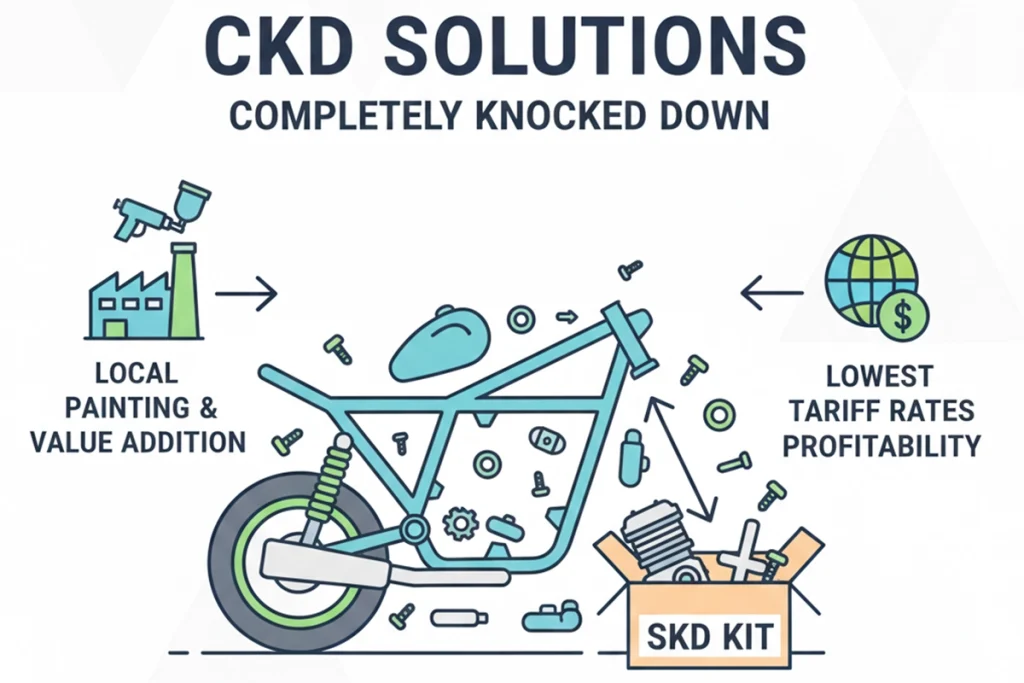
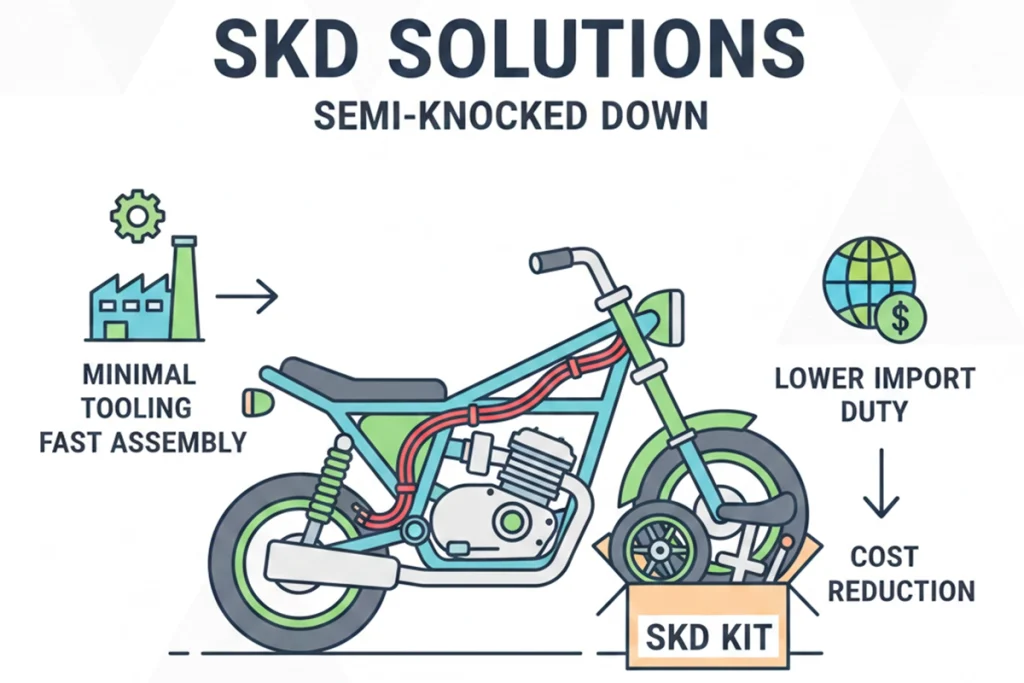
CBU means the motorcycle arrives fully built, SKD arrives as major assemblies, and CKD arrives as a component kit. The choice between CBU vs CKD vs SKD decides your duty bill, your freight per unit, and whether you need a factory at all. This guide compares the three forms on the four variables that matter.
CBU vs CKD vs SKD: The Three Forms Defined
| Form | Arrives as | Destination work |
|---|---|---|
| CBU (completely built up) | Rideable machine, crated | Uncrate, fit bars, PDI |
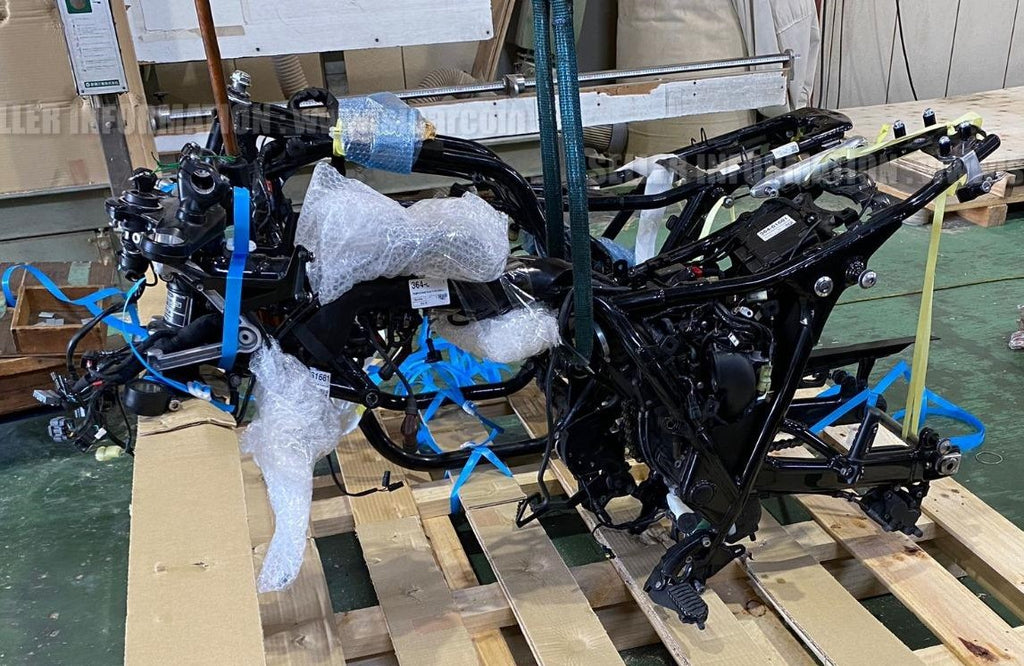
| SKD (semi knocked down) | Engine, frame, wheel assemblies | Line assembly, torque checks |
| CKD (completely knocked down) | Component kits | Full build, tools, jigs, QC |
The naming is industry-standard but the exact breakdown is negotiable. Some ‘SKD’ programs ship the engine already in the frame; others ship them apart. Get the parts list in writing. Our OEM guide covers how this is documented.
Duty: The Biggest Swing Factor
Many markets tax built-up vehicles higher than components, on the explicit policy goal of encouraging local assembly and jobs. That gap can be substantial enough to decide the business case on its own.
[Placeholder: to be confirmed] The exact duty gap must be read from the destination tariff schedule; the same model can face very different rates as CBU and as CKD, so confirm with your broker before ordering.
Freight and Capital
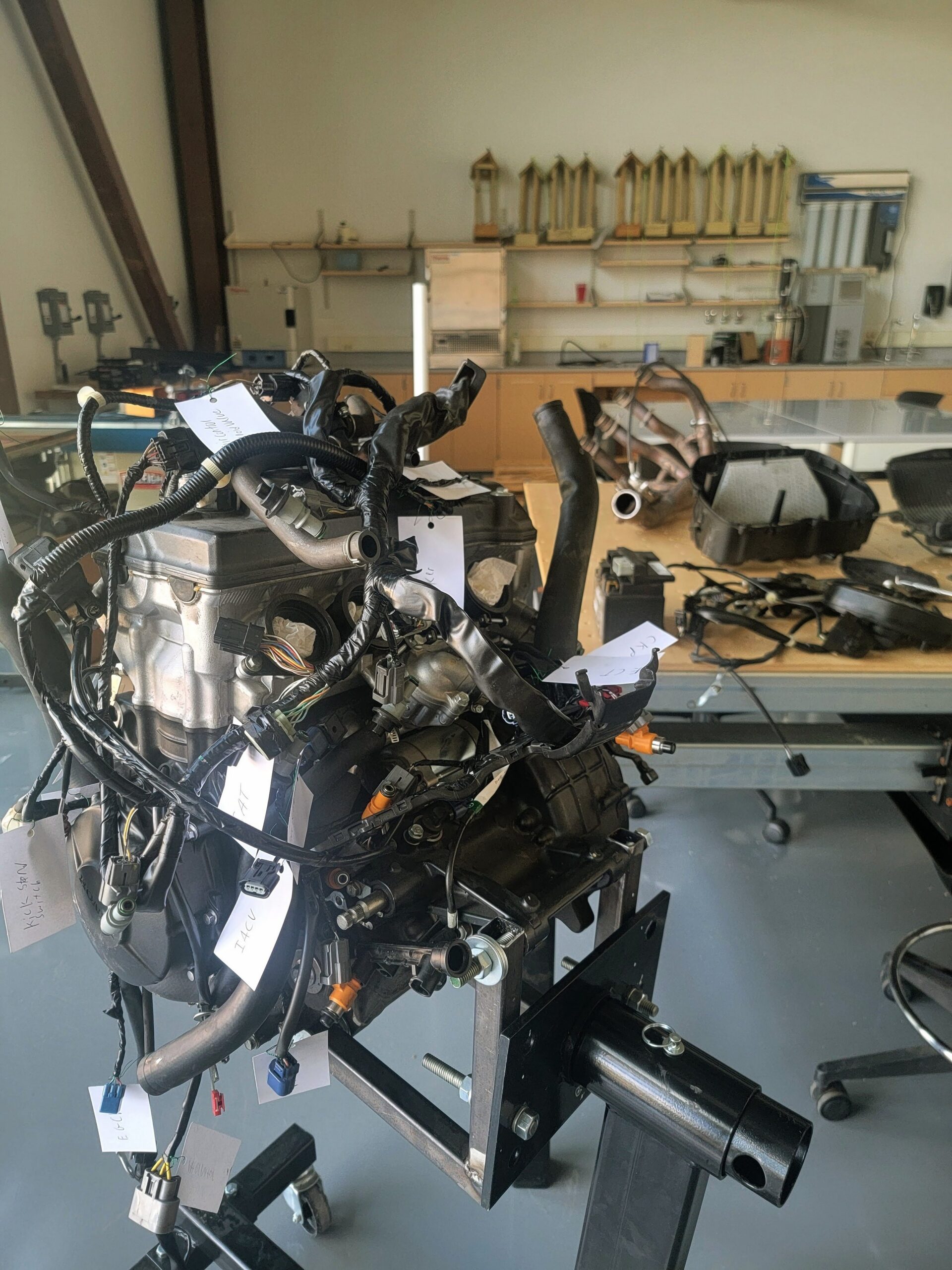
A CKD kit packs denser, so ocean freight per unit falls — but you pay for that saving with an assembly line, torque tools, jigs, and trained technicians. CBU flips both: higher freight, near-zero capital.
The crossover point is volume. Below a few thousand units a year, the line rarely pays for itself. Our bulk purchase model runs the comparison.
Quality Control Is Where CKD Gets Hard
A built motorcycle leaves the factory tested on its own line. A kit leaves untested, so every torque value, electrical connection, and brake bleed becomes your responsibility.
If you go CKD, invest in end-of-line testing at your plant first, not last. The audit protocol adapts well to auditing your own assembly.
Which Form Fits Which Importer
New importers and small markets: CBU, almost always. Established distributors in markets with a duty gap and real volume: SKD as a middle step. National partners with policy support and five-figure annual volume: CKD.
Move down the ladder one rung at a time. Each step changes your operation more than your invoice. The distributor guide maps the operational side.
Frequently Asked Questions
Is CKD always cheaper than CBU?
Not in total cost: CKD usually saves on duty and freight but adds an assembly line, tooling, training, and end-of-line testing, which only pays back at meaningful annual volume.
What is the difference between SKD and CKD?
SKD ships major assemblies such as engine, frame, and wheels for final assembly, while CKD ships component-level kits requiring a fuller build process, more tooling, and deeper technical capability.
Does local assembly affect warranty?
It can; with CKD the destination assembly quality becomes part of the warranty picture, which is why factories usually require documented torque procedures and end-of-line testing before honouring claims.
Can I start CBU and switch to CKD later?
Yes, and it is the common path: importers start with CBU to prove demand, then move to SKD or CKD once volume, duty savings, and local capability justify the line.
Choose the import form on duty gap, volume, and your own technical capability — in that order. Send us your market and annual volume target, and we will return a side-by-side landed-cost comparison for CBU, SKD, and CKD on the models you are considering.
Further Reading
For deeper background, see automotive industry in China on Wikipedia and China Economic Net for industry data.
See also Motorcycle hs code, motorcycle import duty for the detailed version.
CBU vs CKD vs SKD — Import Modes
How a motorcycle crosses the border decides cost, duty and local jobs. The table compares the three.
| Mode | What ships | Trade-off |
|---|---|---|
| CBU | Complete built unit | Simplest, higher duty |
| CKD | Full knock-down kit | Lower duty, local assembly |
| SKD | Semi-knocked-down | Mid duty, less assembly |
Frequently Asked Questions
Which mode for a first order?
CBU — no local assembly line to stand up. Shift to CKD/SKD only when volume justifies a local plant.
Does mode affect compliance?
Yes. Each mode has its own homologation and customs treatment; confirm with a broker before committing.
Terms: payment terms and warranty guide. Context: knock-down kit.